Products/MEMS CO₂ / CH₄
MEMS chemoresistive / calorimetric sensors for CO₂ and CH₄
The integrated heating element consists of a polysilicon layer underneath the active area. A temperature sensitive resistor will enable precisely temperature control. The sensor is integrated as MEMS in CMOS technology compatible by adding special micromachining processes

Package case of sensor for individual gas detection
Characteristics
- The MEMS sensors foe CO2(carbon dioxide) and CH4 (methan) have the operating principle based on the change in conductivity due to chemisorbtion a/o calorimetric effects of gas molecules to be detected at the sensitive layer surface.
- The integrated heating element consists of a polysilicon layer underneath the active area. A temperature sensitive resistor will enable precisely temperature control. The sensor is integrated as MEMS in CMOS technology compatible by adding special micromachining processes.
- Different polymeric films sensitivity gases to be analyzed ,exhibit changes of conductance in presence of small gases concentration at ppm level.
- The sensitivity and stability of MEMS sensors are corresponding for applications during the measurement at room temperature of polluted air .or air noxes detection.
- In some cases a temperature of up to 300° could be applied for cleaning the sensitive polymer in order to reuse the sensor
- The product design by using CONVENTOR with the microprocessing technologies summarized specifically for each type as below:
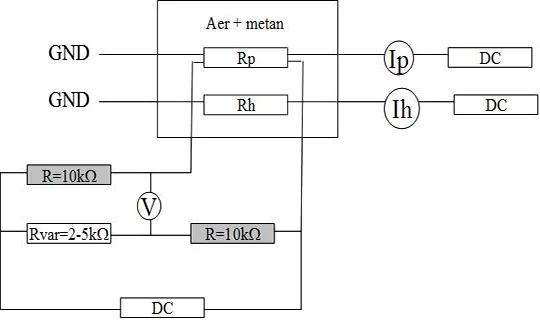
Calorimetric sensor for combustible gas detection CH4 has working between 300-500°C consists of:
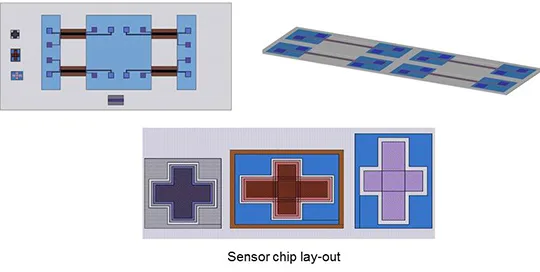
- Integrated heater (patterned layer) on the ceramic Si3N4 membrane suspended on four bridges;
- Dielectric (SiO2 or ceramic) deposited hot plate/electric isolation between heater and sensing electrode.
- Al²O³ sol gel deposited
- Temperature platinum sensor, interdigitated electrode
- Chemoresistive sensor for CO2:
- Integrated heater (patterned layer), SiO2 dielectric
- Sensing electrode interdigitated capacitor Ti/Pt or Ti/W/Au
- Gas sensitive layer SnO2, when heated react with gas molecule changes the resistance of interdigitated capacitor
- The resulting heat is detected as an imbalance of the bridge in which the sensor is connected
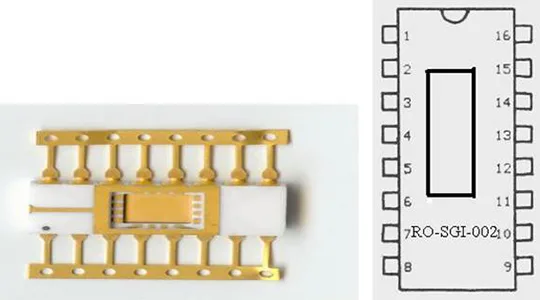
Packaging case for MEMS sensors integrated chips
Advantages
- Increased reproductibility
- High MEMS sensors miniaturization degree
- Microsystem integration in package (sensors, electrodes)
- Low power consumtion, portable devices approaches
- High working versatility as integrated or individual packaged sensors
- Very low weight ~3g

Gas sensor layout
Applications
- Environment protection and monitoring
- Medical and health care applications
- Industrial facilities and utilities networks and production plants
- Chemical and biochemical technological processing
- Safety and defence industry and applications
- Residential and household appliances
Technical features
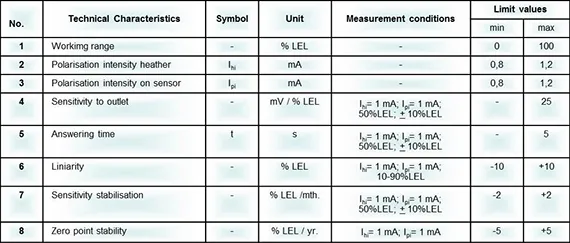
Electric characteristics at +25ºC
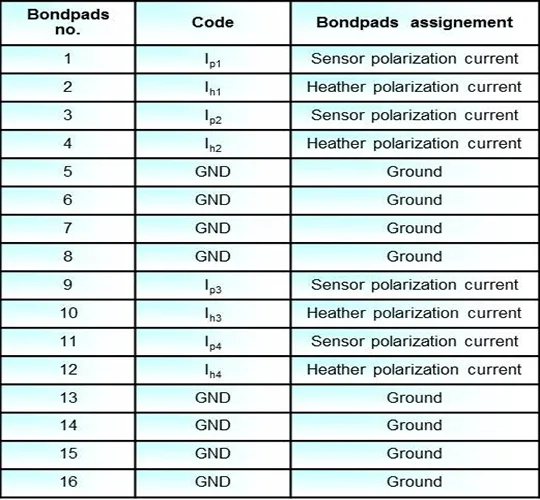
BONDPADS IDENTIFICATION, CODES AND ASSIGNEMENT
Measurement dates
Exemple of measurement dates for sensor sensitivity working as micropelistor for methan detection

Outlet sensitivity control diagramme